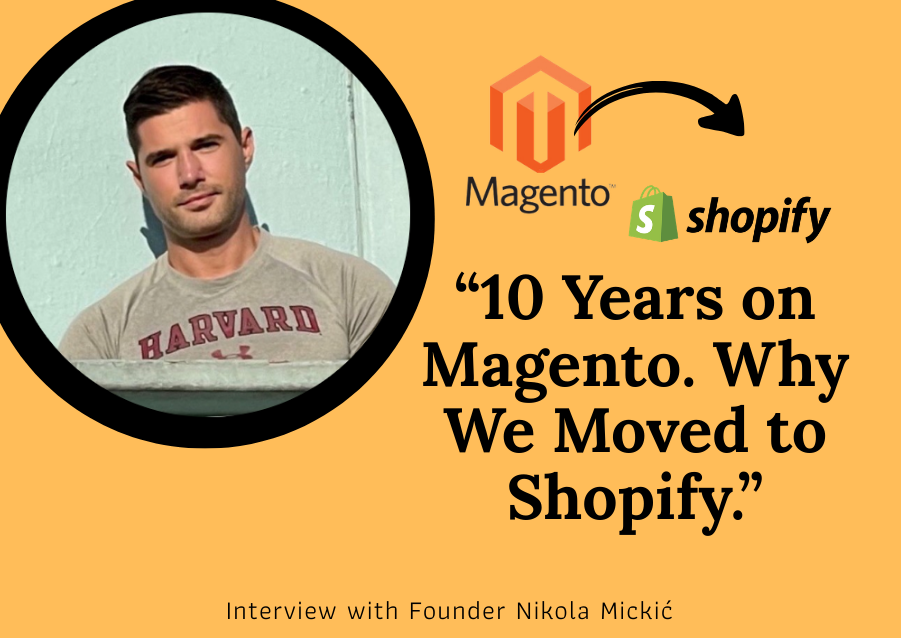
Switching eCommerce platforms after more than a decade isn’t a small decision. Nikola Mickić had built his business on Magento within the Adobe ecosystem for over ten years before deciding to move to Shopify.
We spoke about why that change was necessary, what triggered it, and what business owners should consider before making a similar move.
Q1: Tell us about your company.
Candle Delirium is a specialty fragrance retailer focused on luxury candles, home scents, and artisanal brands from around the world. We operate both a physical retail store and a large e-commerce business, with a strong emphasis on thoughtful brand curation, storytelling, and long-term customer relationships.
Q2: We’ve worked together for almost 10 years, with Magento as your main platform. What motivated you to consider a platform change and a site redesign at this stage?
The primary driver was operational. We were running a brick-and-mortar store on a different system than our online store, with Lightspeed in-store, Magento online, and a third platform, ShipWorks, handling shipping.
There was no single source of truth for inventory, which made management unnecessarily complex and time-consuming.
We wanted one unified system where the physical store, online store, inventory, and fulfillment all lived in one place. Once that decision was made, it also made sense to redesign the site to better support the brand and future growth.
Q3: Before the migration to Shopify, what were the main challenges you were facing with Magento?
Maintenance and speed were the biggest challenges.
Even small changes required significant effort and coordination. Updates were costly, performance optimization was ongoing, and the internal workload kept increasing.
It was also difficult to quickly add or test new applications, especially newer tools around AI and automation. Over time, the platform began to slow down experimentation and decision-making rather than enable it.
Q4: Why did you choose Shopify over other platform
Shopify has become the de facto standard for modern e-commerce. In addition to stability and scalability, it offers a mature ecosystem that customers already trust.
Features like Shop login and payments allow customers to check out quickly without creating separate accounts for every store they encounter, which reduces friction and improves conversion.
From an operational perspective, Shopify provides predictable costs, strong performance, and tools that empower internal teams, making it a strong long-term choice.
Q5: How did the migration process feel from your side as a business owner, especially knowing the store needed to stay stable throughout the transition?
There was some initial anxiety because the store could not afford downtime or SEO disruption.
As the project progressed, the process felt structured and controlled.
Communication was clear, risks were explained upfront, and decisions were made carefully, which built confidence throughout the transition.
Q6: Since launching the new Shopify store, what changes have you noticed in day-to-day operations or customer behavior?
Day-to-day operations are significantly easier.
The team can move faster, manage content more independently, and respond to business needs without heavy technical involvement.
From the customer side, the site feels faster and more intuitive, and we have seen an increase in conversion rate compared to the old setup.
Q7: SEO was a critical part of the migration, especially the redirect work. At one point you said, “You’re the expert.” Looking at the results a few months later, how do you feel about trusting that decision?
It was absolutely the right decision.
We had over 55,000 existing URLs, and there was real concern about losing SEO equity during the migration. The team did an excellent job planning and executing the redirect strategy.
All of the redirects were handled extremely well, rankings remained stable, traffic recovered quickly, and there were no major issues. It reinforced how important experienced SEO execution is during a migration of this size.
Q8: Looking back at the whole project, what would you say to other store owners who are considering a similar migration?
I would strongly recommend it, especially if you are dealing with operational complexity or legacy systems.
With the right planning and the right partner, the transition can be smooth and extremely worthwhile.
From our experience, Shopify is the right choice for businesses looking for scalability, simplicity, and long-term efficiency.
Q9: From your experience, do you feel Upment was the right partner to handle a project of this scale and complexity?
Yes, without question.
We had years of experience maintaining our Magento site, so we understood how complex that ecosystem can be.
Working with a team that has deep expertise in both Magento and Shopify made a huge difference.
Upment understood the nuances of both platforms, the risks involved, and the business impact of each decision, which made them the right partner for a project of this scale.
 Twitter Social Network
 Instagram Social Network
 Facebook Social Network
 Linked In Social Network