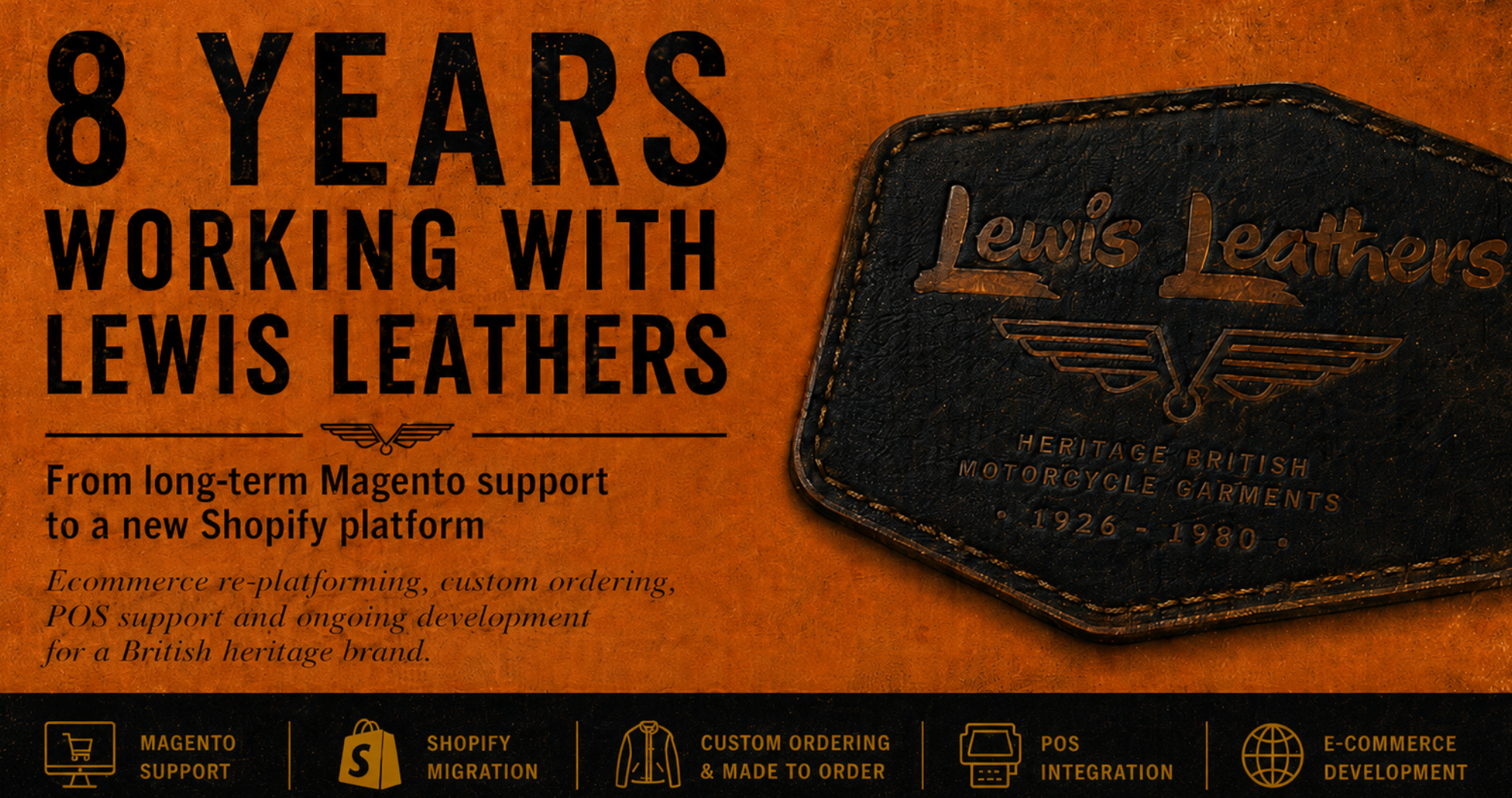
Lewis Leathers is not the kind of brand you treat like a normal ecommerce project.
Founded in 1892, Lewis Leathers has built its name over generations. The brand has history, character, loyal customers, and a very clear identity. That means every change to the online store has to be handled carefully.
Our relationship with Lewis Leathers started years before the move to Shopify. We had already been working with their team on the Magento store, supporting the existing setup, helping with improvements, and solving problems as they came up.
Over time, that work built trust.
So when the decision was made to move from Magento to Shopify, this was not just a technical migration for us. It was a project where we already understood the brand, the people behind it, and the importance of keeping the store familiar for customers while making it easier to manage for the team.
The goal was not to change what makes Lewis Leathers special. The goal was to give the brand a cleaner, more stable platform for the next stage of its online growth.
Why the Move to Shopify Made Sense
For Lewis Leathers, the London store has always been at the centre of the business. The online store needed to support that experience, not sit separately from it.
Magento had supported the online side of the business for years, but the needs of the team had changed. The store needed a setup that worked better for both online customers and the staff managing sales in person.
One important part of the move was Shopify POS.
With Magento, the point-of-sale system was not a natural part of the platform. That meant the in-store side of the business had to be managed separately from the online store, which added extra work for the team.
Shopify made this easier because POS is part of the Shopify ecosystem. For the staff in the London store, this was a big relief. They could manage online and in-store sales inside one platform, with less switching between systems and fewer separate processes to deal with.
The product catalogue itself was not unusually large, but for a brand like Lewis Leathers, every product page, image, description, and search result matters. The move had to be handled carefully so the brand’s SEO value was not lost. The goal was not only to preserve what was already working, but also to create a cleaner structure that could support better search visibility in the future.
There was also another important part of the project: the Japan store.
Lewis Leathers has a strong following in Japan, where the brand’s merchandise is especially popular with a younger audience. The Japan store was running on older custom software, which made it harder to manage and improve over time. Modernising that store and making it easier for the team to operate was another key goal.
At the time of writing, the UK store had already moved from Magento to Shopify and was running on the new platform. The Japan migration was still in progress, with a separate case study to follow.
So the move to Shopify was not just a platform change. It was a practical step toward a simpler, more connected setup that supports the London store, the online store, and the future growth of Lewis Leathers in both the UK and Japan.
Preserving the Way Lewis Leathers Works
One of the most important parts of this project was understanding that Lewis Leathers does not operate like a standard online fashion store.
A jacket from Lewis Leathers is not just selected, added to cart, and shipped from a warehouse. For many customers, it is a personal order. The jacket is made with specific choices, details, and preferences, and that process had to be protected during the move to Shopify.
Years before the Shopify migration, our team had already built a custom jacket configuration module for Lewis Leathers on Magento. This allowed customers to configure men’s and women’s leather jackets online by selecting the leather type, colour, size, lining, zip options, special options, pocket position, logo type, and logo position.
That module was an important part of the online store because it reflected how Lewis Leathers actually sells its jackets. The customer is not only buying a product. They are making choices that affect how the final jacket will look and feel.
When the migration to Shopify started, this was one of the areas that needed special attention. A simple product options setup was not enough. The existing process had to be rebuilt in a way that worked inside Shopify, while still keeping the ordering experience clear for customers and manageable for the Lewis Leathers team.
The original Magento module was later translated into a Shopify app, so the custom jacket ordering process could continue on the new platform.
Another important part of the project was the made-to-order process.
For the online store, Lewis Leathers jackets are made to order. Customers place their order and wait for their jacket to be made. Ready-made jackets are available only through the physical London store, which remains at the centre of the brand experience.
This distinction was important. The online store had to explain and support the made-to-order process properly, while the London store continued to serve customers who wanted to visit in person and buy available ready-made pieces.
The level of trust around the Lewis Leathers brand is one of the reasons this model works. Customers are willing to wait, sometimes for a very long time, because they know what they are ordering. Over the years, that waiting time has grown from a few months to much longer in some cases, which also shows how demand for Lewis Leathers jackets has continued to grow.
That demand is not only about motorcycle clothing. It is also about the vintage style, the history of the brand, and the way Lewis Leathers jackets have become part of a wider culture around British leather garments, music, riding, and personal style.
The heritage also goes beyond motorcycle jackets. The Aviakit name, still connected with Lewis Leathers, comes from the company’s earlier association with aviation clothing and equipment. That detail matters because it shows how deep the brand history is, and why the online store needed to respect the original character of the business.
Beyond the custom ordering and made-to-order flow, there were also practical requirements around selling internationally.
The UK store needed multilingual, multicurrency, and multi-store support. It also needed to meet EU compliance requirements, including GPSR-related product safety information. These details are not always visible to customers, but they are important for a brand selling across different markets.
Shipping was another area that needed attention. Lewis Leathers uses carriers such as Royal Mail and DHL, so the shipping setup had to be adjusted around the way the business actually fulfils orders.
Finally, there was the look and feel of the store.
For a brand like Lewis Leathers, using a standard ready-made Shopify template was not the right approach. The website needed to keep the vintage, recognisable, and authentic look of the brand. The goal was not to make the store look like every other modern ecommerce site.
Because of that, the Shopify theme was built from start to finish around the Lewis Leathers identity, rather than forcing the brand into a generic template.
This made the project more complex, but it was necessary. The migration had to protect the way Lewis Leathers works: the London store, the made-to-order process, the custom jacket options, the international requirements, and the visual character of the brand.
The Next Step: A More Connected Customer Setup
The move to Shopify was an important step, but it was not the end of the work.
Another area we discussed with the Lewis Leathers team was customer communication and CRM. Until now, they had not been using a dedicated CRM system in the background. Email campaigns were handled separately, and for a brand that only sends a few campaigns during the year, the cost of traditional email marketing tools can easily become higher than it needs to be.
Our suggestion was to bring Lewis Leathers into a simpler customer management setup, connected around the way the business actually works.
The goal is not to make things more complicated for the team. It is the opposite. A CRM gives the staff one place to manage customer communication, email campaigns, simple follow-ups, and future marketing activity without relying on too many separate tools.
It also opens the door for more options later: SMS campaigns, automated workflows, sales funnels, opportunity tracking, review and reputation management, and AI-assisted chat tools.
Lewis Leathers already has the strongest advantage any business can have: a trusted brand with a loyal audience. But there is still room to support that with smaller, more focused marketing campaigns, whether through email, paid ads, remarketing pixels, Google, Meta, Reddit, or other channels that make sense for the brand.
For us, this is also where the project continues beyond the migration itself. Our role is not only to build the technical setup, but also to support Lewis Leathers with the practical business side of running and improving their online presence.
The Shopify migration gave the brand a cleaner and more stable platform. The CRM layer gives the team more control over customer communication and future marketing.
That is the direction we see for the next stage of our work together: not changing what makes Lewis Leathers special, but giving the team better tools to support the brand, the customers, and the long-term growth of the business.
 Twitter Social Network
 Instagram Social Network
 Facebook Social Network
 Linked In Social Network